Should Your Child Take Higher Chinese? 7 Questions for Parents
By HAO Chinese Tuition · · Updated · 5 min read
By HAO Chinese Language Centre · Originally published 31 January 2023 · Updated 10 November 2026
Should your child take Higher Chinese? Consider it when your child enjoys Chinese, can manage their current work and is willing to explore more demanding reading and writing. Discuss the school’s recommendation and actual lesson load with their teacher. Eligibility, readiness and interest are separate questions; a good decision considers all three.
Higher Chinese Language (HCL) is the Chinese option within Higher Mother Tongue Language (HMTL) at school. It develops language skills beyond the standard course at the relevant school level. Primary and secondary Higher Chinese have different requirements, so start with your child’s stage rather than treating them as the same course.
Seven questions to discuss- How comfortable is your child with Chinese now?
- Does your child want to learn more?
- Can the weekly workload fit?
- What are the school’s entry requirements?
- What does Higher Chinese change for PSLE and school choices?
- What practice would help?
- What should you ask the teacher before deciding?
1. How comfortable is your child with Chinese now?
Look at recent work alongside marks. Can your child explain a passage in their own words, describe why a character acted in a certain way and write connected sentences? Notice which tasks they complete independently and where they need repeated prompting.
Bring one recent comprehension exercise and one composition to the teacher discussion. Ask whether the next step should be extending ideas and expression or strengthening vocabulary and basic understanding. This gives you a clearer starting point than a single test score.
2. Does your child want to learn more?
Ask what your child enjoys about Chinese: a story, a conversation with grandparents, a favourite character or a topic they want to read about. An interest outside tests can give them a reason to keep using the language when tasks become harder.
Listen to concerns as well. “I do not know enough words” calls for a different response from “I have no time after school.” Agree on a manageable learning goal together, such as explaining a short story more clearly, rather than focusing only on the subject label.
3. Can the weekly workload fit?
Ask the school for its actual timetable, homework expectations and assessment arrangements. There is no useful universal estimate of extra lessons or vocabulary for every school, level and child.
- List schoolwork, travel, co-curricular activities and existing classes for a normal week.
- Leave room for rest and activities your child enjoys.
- Ask how the teacher will flag difficulties and when the family can review the subject choice.
If Chinese work already takes a long time, discuss the specific difficulty before adding more practice. Choosing a course that your child can sustain matters alongside eligibility.
4. What are the school’s entry requirements?
Primary school
Check your own school’s current offering, selection process and recommendation. For example, Methodist Girls’ School describes offering HMT from P3 to students with proficiency and strong interest. That is an example of one school’s provision, not an entry rule for every primary school. Avoid relying on a general “70 marks” rule or assuming all schools start at the same level.
Secondary 1: the rule from 2026
MOE states that students entering Secondary 1 from 2026 can offer HMTL if they attain AL1 or AL2 in their PSLE Mother Tongue Language, or Distinction or Merit in PSLE HMTL, regardless of their overall PSLE score. See MOE’s announcement on increased HMTL opportunities.
MOE’s current eligibility guidance also explains that schools have flexibility to admit students outside those criteria when they assess exceptional MTL ability and the capacity to cope with other subjects. Ask the receiving school about its process and arrangements.
5. What does Higher Chinese change for PSLE and school choices?
Higher Chinese does not subtract points from the PSLE Score. MOE calculates that score from the Achievement Levels of English, Mathematics, Science and Mother Tongue Language.
There is a separate posting advantage for Special Assistance Plan (SAP) schools. Students with a PSLE Score of 14 or better and a Pass, Merit or Distinction in HCL are eligible. Among students with the same PSLE Score applying to the same SAP school, a better HCL grade takes priority before the other S1 posting tie-breakers. Read MOE’s PSLE scoring and SAP posting explanation for the full context. This is not a guarantee of a place.
Higher Chinese can also offer a route to deeper reading, more precise expression and continued language learning. Weigh those goals against your child’s interests and workload. For later junior-college admission or Mother Tongue requirements, check the rules for your child’s actual cohort with MOE and the school; taking Higher Chinese alone does not establish an exemption or admission outcome.
6. What practice would help?
Use a short passage or a piece of schoolwork to identify one next step. The following is an original home-practice example, not an examination question, model answer or assessment of eligibility.
Example: “小明看见同学独自坐在一旁,便走过去邀请他一起玩。” Ask: What did Xiaoming notice? What did he do? What might his action tell us about him? Invite your child to point to words in the sentence and explain their reasoning. Discuss more than one sensible interpretation rather than memorising a fixed answer.
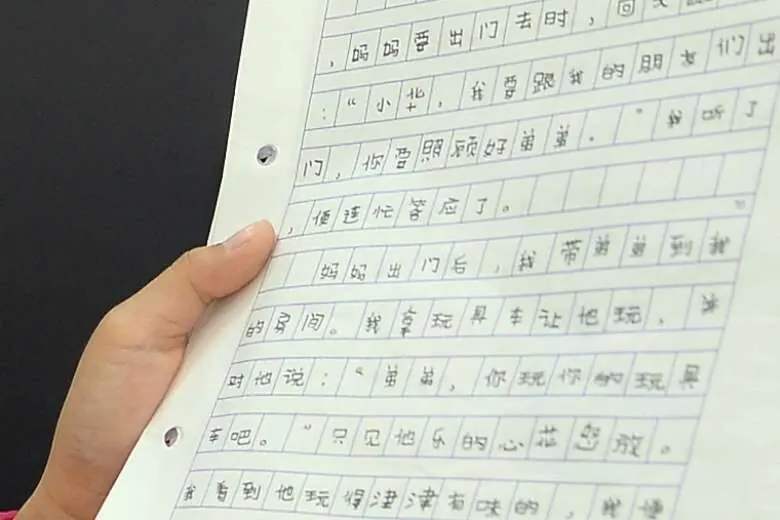
For writing, choose one paragraph and check the order of events, word choice and whether the reader can follow the meaning. Our Chinese composition practice guide offers further steps. You can also browse the free Chinese learning resources and choose material appropriate to your child’s level.
7. What should you ask the teacher before deciding?
Use these questions for a discussion with your child’s school teacher:
- Which recent work shows that my child is ready for a more demanding course?
- What is the main skill they should strengthen first?
- What will the weekly lessons and homework involve at this school?
- How will we review progress if my child finds the pace difficult?
- What options and deadlines apply if their needs change?
Write down the school’s advice, your child’s view and one agreed next step. Revisit the decision with evidence from their work rather than comparing only with classmates.
Chinese learning support at HAO
HAO’s Primary All-in-One Chinese Programme offers Higher Chinese for P1–P4 and Standard Chinese or Higher Chinese for P5–P6. These are HAO’s class pathways; they do not determine a school’s subject placement.
The Secondary All-in-One Chinese Programme supports S1–S4 students taking G3 Chinese or Higher Chinese. Compare the Chinese tuition and enrichment programmes, then find one of HAO’s six centres and ask about the class suited to your child’s current needs.
School-policy sources checked on 10 November 2026. This guide provides parent discussion prompts; your child’s school confirms its subject offering, placement and arrangements.