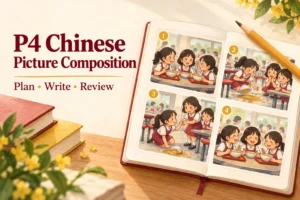
Clear Chinese composition depends on a story the reader can follow, relevant details and language the writer understands. These five practice habits help primary students review their writing without relying on memorised essays or promises of a particular grade.
1. Plan the event before choosing phrases
Start with a short outline: where and when the event begins, what problem occurs, how the characters respond and how the situation ends. For picture-based practice, check the entire sequence before deciding what to write about the first picture.
Ask your child to explain the cause of each event. “She was careless” is less specific than explaining what she did and what happened next. A simple, connected sequence gives later details a clear purpose.
Use HAO’s P4 picture-composition worksheet and planning guide to practise this with a four-picture canteen story. It is a P4 home-practice resource, not a PSLE examination paper.
2. Choose language that fits the situation
Before adding a descriptive phrase, ask: what does it mean, and why does it belong in this sentence? An expression about happiness will not fit a moment when a character is frightened or embarrassed.
Keep a small vocabulary notebook organised by purpose—actions, feelings, sounds and descriptions. Add a short sentence beside each new expression. During revision, ask your child to explain that sentence rather than recite a list of phrases.
Read our guide to writing without memorising model essays for another way to practise selecting language independently.
3. Show actions and feelings through relevant details
A general statement such as “He was worried” tells the reader the feeling. A specific action can help explain it: perhaps the character searches a schoolbag again, checks under a desk or asks a friend for help.
Choose details that belong to the actual event. There is no need to add every possible facial expression or movement. Two useful questions are “What does the character do?” and “What causes that response?”
Short dialogue can also clarify an event. Let it show a request, a response or a change in understanding. Read the conversation aloud to check whether it sounds natural and moves the story forward.
4. Keep the people and sequence clear
Use character names consistently. When several people appear, repeated pronouns can leave a reader unsure who is speaking or acting. Check the subject of each sentence and add a name where needed.
Linking words should express a real relationship. A word meaning “later” shows a time change; a word meaning “therefore” connects a result to its cause. Avoid using the same connector mechanically at the start of every sentence.
After drafting, ask your child to summarise each paragraph in one sentence. If two paragraphs do the same job or the story jumps over an important event, revise the outline before polishing individual words.
5. Review one writing decision at a time
Use a first read for meaning and a second read for sentence-level checks. It is easier to notice a missing explanation when you are not trying to correct every character at the same time.
- Meaning: can the reader understand the beginning, problem, response and ending?
- Relevance: do the details support the event rather than distract from it?
- Clarity: is it clear who acts and speaks?
- Language: are words understood and used appropriately?
- Accuracy: have incomplete sentences, punctuation and uncertain characters been checked?
When using a model composition, compare one technique—an opening, an action or the ending—then let your child revise their own paragraph. Copying a corrected essay does not show whether the child can make the same choice in a different story.
Chinese composition support at HAO
HAO’s Primary All-in-One Chinese Programme covers vocabulary, comprehension, composition, oral and listening. Students receive individual composition and oral feedback within the programme. P1–P4 classes offer Higher Chinese only; P5–P6 offer Standard Chinese and Higher Chinese.
Browse the free learning resources for home practice, or find your nearest HAO centre to ask about a suitable class and free-trial availability.