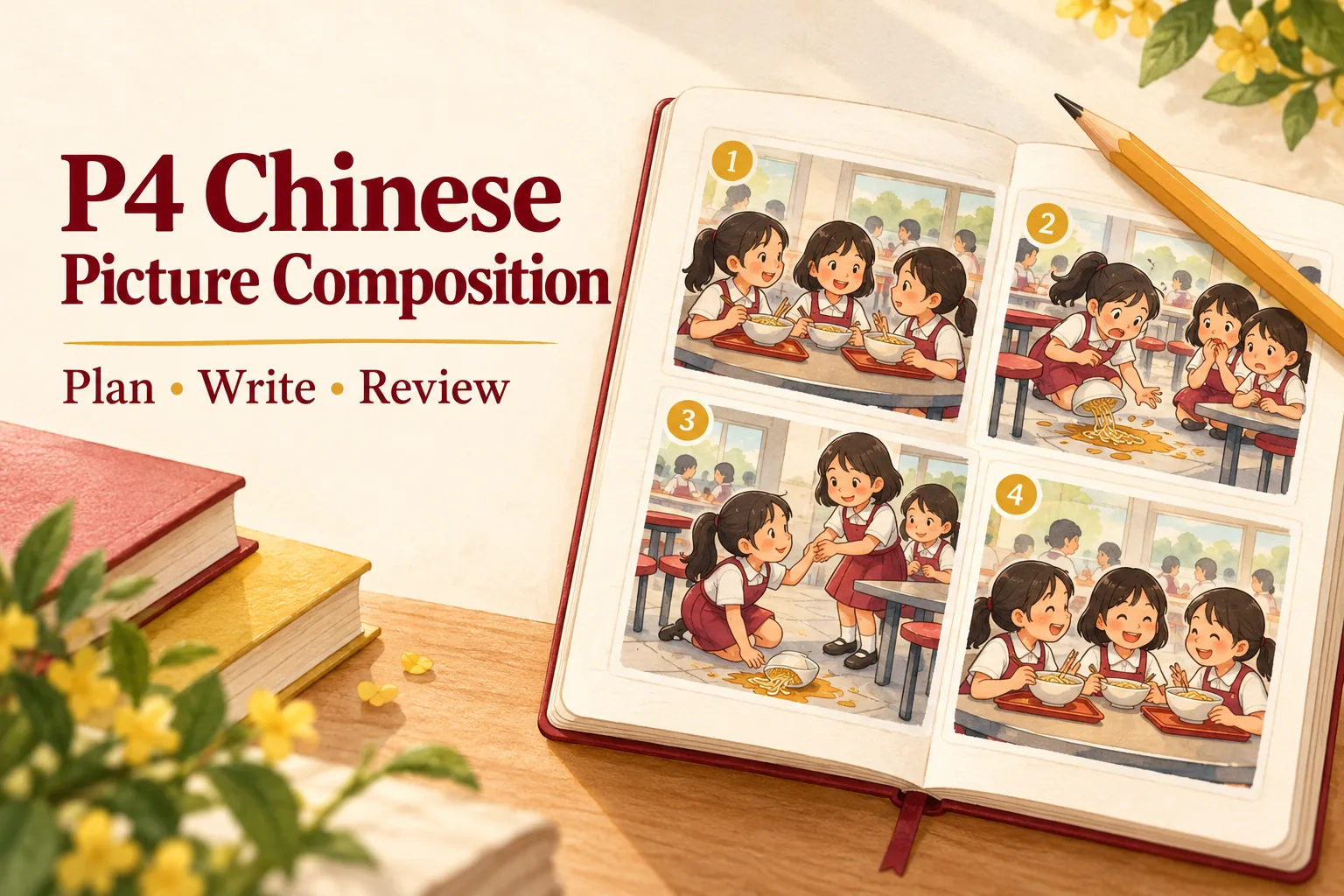
For P4 Chinese picture composition, start by explaining what happens and why before choosing impressive phrases. Look through every picture, identify the problem, plan how the characters respond and write a connected ending. HAO’s two-page practice resource includes four pictures and a model composition about classmates helping one another in a school canteen.
This guide helps parents use the existing worksheet for home practice. The PDF’s second page contains a model composition; try planning from the first page before reading it. The model is one possible response, not an answer your child needs to memorise.
What is happening in the four pictures?
The worksheet is titled 小四:看图作文. Its setting is the school canteen during recess, with three girls as the main characters. A girl slips on water on the floor and spills her food. Her classmates help her, and the story ends with the friends together again.
Picture 1: Recess
Notice: The girls are in the canteen with their food.
Ask your child: Where are they? What is each girl doing before the accident?
Picture 2: The accident
Notice: Water on the floor causes a girl to slip and spill her noodles.
Ask your child: What causes the accident? What happens to the tray and food? How might she feel?
Picture 3: Help arrives
Notice: A classmate helps the girl while another responds to the situation.
Ask your child: Who notices first? How can each friend help? What could they say?
Picture 4: Together again
Notice: The girls are together at the table, with food for their friend.
Ask your child: How has the problem been resolved? What shows that her feelings have changed?
Point to details in the pictures as your child explains the events. A useful question is “为什么会这样?”—why did that happen? This encourages a connected story rather than four unrelated descriptions.
Plan a beginning, problem, response and ending
Before writing full sentences, make four short notes. Your child can say the notes aloud in Chinese or write key words. Keep the plan small enough to use while writing.
- Beginning: introduce recess, the canteen and the friends. Give readers enough context to understand the next event.
- Problem: explain the water, the slip and the spilled food in a clear order.
- Response: show what the friends do to help. Make sure their actions address the problem.
- Ending: resolve the incident and show how the girl responds to her friends’ kindness.
Choose names and use them consistently. If every sentence refers only to “she”, a reader may lose track of who is carrying the food, who slips and who helps.
Use linking words to show relationships
Words such as 这时 (at this moment), 于是 (so) and 后来 (later) can connect events. Choose a word because it expresses the relationship between two events; adding one to every sentence does not automatically make a story clearer.
Add details that help the reader follow the story
Show the action
Ask your child to explain the movement: carrying a tray, stepping on water, losing balance or helping a friend sit down. A clear action often tells the reader more than a general sentence such as “An accident happened.”
Connect feelings to what happens
A character may feel happy before the accident, shocked when the bowl falls and grateful after receiving help. Ask, “What made her feel this way?” Then add a relevant action or expression. Keep the emotion consistent with that point in the story.
Give dialogue a purpose
A short line of dialogue can explain the problem or show kindness. Read it aloud: does it sound like something one classmate might say to another? Avoid long conversations that stop the event from moving forward.
For another way to practise these choices, see our guide to improving Chinese composition without memorising model essays.
How to learn from the model composition
After your child has planned or drafted a response, open page two. The resource labels its opening, picture-based paragraphs and reflective ending. It also highlights expressions within the model.
- Compare the sequence: can your child match each model paragraph to a picture?
- Find one useful detail: ask how an action, expression or short line of speech helps the reader understand the event.
- Check meaning: before borrowing an expression, ask your child to explain it and why it fits.
- Revise one part: improve a sentence or paragraph in your child’s own draft rather than copying the model.
The PDF describes its model as approximately 400 Chinese characters. That describes this particular example; it is not a statement of a universal P4 examination requirement. Follow the instructions given for your child’s actual school assignment.
A parent-and-child review checklist
- Can a reader tell when and where the story happens?
- Are the main characters and their names consistent?
- Is the cause of the accident clear?
- Does the response explain how the classmates help?
- Do feelings, actions and dialogue fit the events?
- Does the ending resolve the incident instead of stopping suddenly?
- Have unfamiliar words, punctuation and incomplete sentences been checked?
Start feedback with one part that is clear, then choose one improvement to discuss. Ask your child to explain the revision. A worksheet is most useful when it helps the child make a writing decision, not just produce a corrected copy.
Questions parents ask about P4 看图作文
Should my child read the model essay first?
For this activity, let your child describe the pictures and make a short plan first. Compare the model afterwards to notice how another writer develops the same sequence. If your child is stuck, discuss one picture together before returning to independent writing.
Must every highlighted expression appear in the composition?
No. The highlighted language is a learning aid. Use an expression only when your child understands it and it fits the event. Clear meaning matters more than collecting difficult phrases.
Where can I find the original pictures and model?
Both pages are in the original P4 picture-composition PDF. You can also browse HAO’s free Chinese learning resources for character-writing and comprehension practice.
Looking for structured primary Chinese support?
HAO’s Primary All-in-One Chinese Programme connects vocabulary, comprehension, composition, oral and listening, with individual composition and oral feedback. P1–P4 classes offer Higher Chinese only; P5–P6 offer Standard Chinese and Higher Chinese.
Explore programme details and fees, then find your nearest HAO centre to confirm class suitability, timetable and free-trial availability.